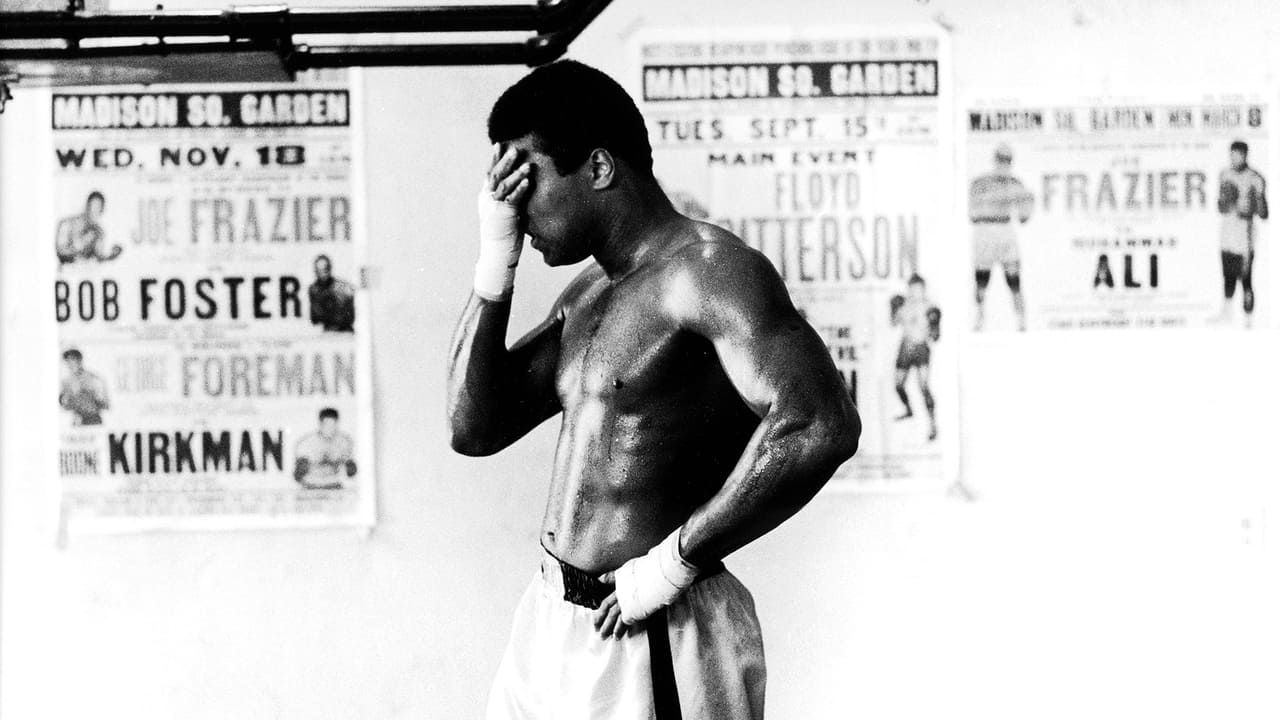
I Am Ali is a 2014 documentary directed by Clare Lewins. It covers the life of professional boxer Muhammad Ali. The film tells his story using personal audio recordings Ali made himself during the 1970s. Additionally, interviews of friends, family members, and people associated with professional boxing, combined with archival footage of Ali, are used throughout the movie. Notable appearances in the film include George Foreman, Jim Brown, and Mike Tyson.
The film begins with a phone call between Ali and his daughter Hana that took place on November 30, 1979. In the call Ali tells Hana, a young child at the time, that he might fight in one final boxing match. Hana tells him not to do it. The film then transitions to Ali's last professional fight, which took place in 1981, two years later.
According to director Clare Lewins, she did not want to cover Ali's entire life in a linear manner, but instead wished to start with his decision to accept that final professional fight.[ 1]
From there, glimpses of Ali's life are shown through archival footage, interviews with friends and family, and many more of Ali's personal audio recordings. Notable periods of his life are covered by interviews with those who knew him best, and others who considered themselves fans and admirers. Through these devices the documentary looks back at Ali's life, beginning with early childhood. Scenes include a retelling of the theft of Ali's bicycle when he was a child. That crime played a key role in his entering the sport of boxing when he was twelve years old. Ali's brother Rahaman states that even from those early teen years Ali felt he would become one of the greatest boxers of all time.
Numerous audio clips from various sources featuring Ali's voice are presented throughout the movie. A wide range of moments are covered in these recordings. They include Ali singing with his daughter Hana, his discussions with the White House, and a conversation with a pizza delivery man who stopped by Ali's home.
The documentary also focuses on Ali's relationship to the boxing world. Ali's boxing matches with various rivals, including Joe Frazier, George Foreman, and Sonny Liston are discussed. Former heavyweight champion Mike Tyson talks about how he aspired to fight at the same level as Ali. George Foreman shares how Ali would tease and taunt him during their boxing matches. Singer Tom Jones talks about his admiration for Ali's boxing skills and persona. Former business manager Gene Kilroy weighs in on several topics. Also interviewed is photographer Carl Fischer, who took photos of Ali for the cover of Esquire.
Another topic touched on is Ali's conversion to Islam, including why he changed his name from Cassius Clay to Muhammad Ali. That line of exploration also includes Ali's conscientious objector status to the Vietnam War, and his refusal to join the military based on his religious beliefs.
Ebony described the film as follows:
Of the film, Ali's daughter Hana felt her father would be happy with Lewins' direction of the film, especially the depiction of Ali's "loving side."[ 3]
The Chicago Tribune said, "At its best, I Am Ali offers something the big-budget biopic Ali could not: casual intimacy."[ 4]
NPR stated, "What distinguishes Lewins' entertaining-if-not-terribly-revelatory film from the many Ali documentaries that have come before is its focus on this most public of personalities as a friend and father."[ 5]
The Guardian called the film "warm hearted and respectful" and a "very watchable tribute" though it felt it might not live up to other films about Ali.[ 6]
There was no soundtrack album issued with the music of the film. The tracks featured in the film were the following:[ 7]
Bewertungen im Detail
Auf anderen Plattformen
Rezension zu I Am Ali
Muhammad Ali alias Cassius Clay war einst der erste Popstar des Sports und ist auch heute noch, gezeichnet von der Parkinsonkrankheit, für viele Amerikaner ein Vorbild und eine Identifikationsfigur. Sein Leben ist zigfach erzählt. Das muss man voraus schicken, wenn man »I am Ali« betrachtet, einen neuen Dokumentarfilm, der das Leben Alis mit seinen eigenen Worten erzählen will - und dies mittels alter Tonbänder, die der Boxer selbst während seiner Karriere besprochen hat.
Im Jahre 2001 brachte der amerikanische Regisseur Michael Mann den jungen Will Smith in der Rolle von »Ali« ins Kino. Der Film spielte weltweit immerhin 87 Millionen Dollar im Kino ein - davon in Deutschland 2 Millionen. Bei 107 Millionen Dollar Kosten war »Ali« also finanziell ein Flop. Aber zwei Oscar- und drei Golden-Globe-Nominierungen erreichen auch nicht viele Kinogeschichten.
Dabei ist die Geschichte von Cassius Clay alias Muhammad Ali, einem der wohl bis heute bekanntesten amerikanischen Sportler, schon immer filmreif gewesen. Schon 1996 drehte Leon Gast »When We Were Kings«, einen Dokumentarfilm, der vom »Rumble in the Jungle« berichtete. Er zeigt Muhammad Ali und George Foreman bei ihren Vorbereitungen zu dem Schwergewichtskampf. Der Film erhielt 1996 den Oscar als bester Dokumentarfilm. Im Kino spielte er keine drei Millionen Dollar ein, wird aber alle paar Jahre inzwischen auch im deutschen Fernsehen gezeigt.
Ein paar Jahre weiter muss man zurück gehen um das Dokudrama »Ich bin der Größte« zu entdecken, in dem die Schauspieler Ernest Borgnine und Robert Duvall mitwirkten. Er hinterließ keine große Wirkung - ebenso wie der 1969 von William Klein gedrehte Dokumentarfilm »Muhammad Ali, der Größte«. Allerdings zeigte der politisch engagierte US-Filmemmacher vor allem jene Seite Alis, die nicht ideal zur Rolle des Popstars passte: Ali als Kämpfer für die Rechte der Afroamerikaner.
Und hier schließt sich der Kreis, denn die amerikanische Filmemacherin Clare Lewins, die bisher nur eine Dokumentation über die britische Krimiautorin Agatha Christie vorzuweisen hatte, will auch die verborgenen Seiten von Cassius Marcellus Clay Jr. zeigen. Dazu durfte sie aus Alis privatem Archiv die als »Audio Journals« bezeichneten Tonbänder auswerten, die der Sportler selbst besprochen hatte. Sie kombiniert dies mit Interviews als Alis engstem Familien- und Freundeskreis.
Die persönliche Seite Alis, sonst eher ein Randthema bei der Berichterstattung über den mittlerweile 72 Jahre alten Ex-Boxer, steht ganz im Vordergrund bei »I am Ali«. Das sei »heartwarming«, schreibt die amerikanische Presse. Herzerwärmend. Sogar George Foreman und Mike Tyson werden da im Interview ganz weich. Und ja, es laufen Tränen. Allerdings dürfte fraglich sein, ob die deutschen Kinozuschauer so viel Herz für Ali aufbringen. Der war in seiner aktiven Zeit bei uns eher als »Sportkasper mit fetten Muskeln« bekannt.
Für amerikanische Zuschauer allerdings ist Ali noch immer einer der Größten. Und so dürfte es kein großes Wunder sein, wenn dieser Film, der zeitgleich auch in den amerikansichen Kinos startet, nicht in Kürze auf der Nominierungsliste für den Doku-Oscar 2015 auftauchen würde.
10.10.2014